Put simply, an Option is a derivative contract that gives the holder (the buyer) the right, but not the obligation, to buy or sell an asset by a certain date at a specified price.
Meaning the holder can choose whether to exercise that option (trade) when the time comes. This contrasts with an FFA contract which imposes an obligation to trade on both parties. An options value is tied to the underlying asset, which in this case is the FFA contract.
Freight options are European options, meaning they are only exercised at expiry and depend upon the spot price of the underlying future at expiration. For sake of completeness, there are also American options which can be exercised at any time prior to expiration and are therefore priced higher than European options, and Asian options where the payoff depends on the average price of the underlying asset over a certain period.
There are two types of options, a Call Option and a Put Option:
Call Option:
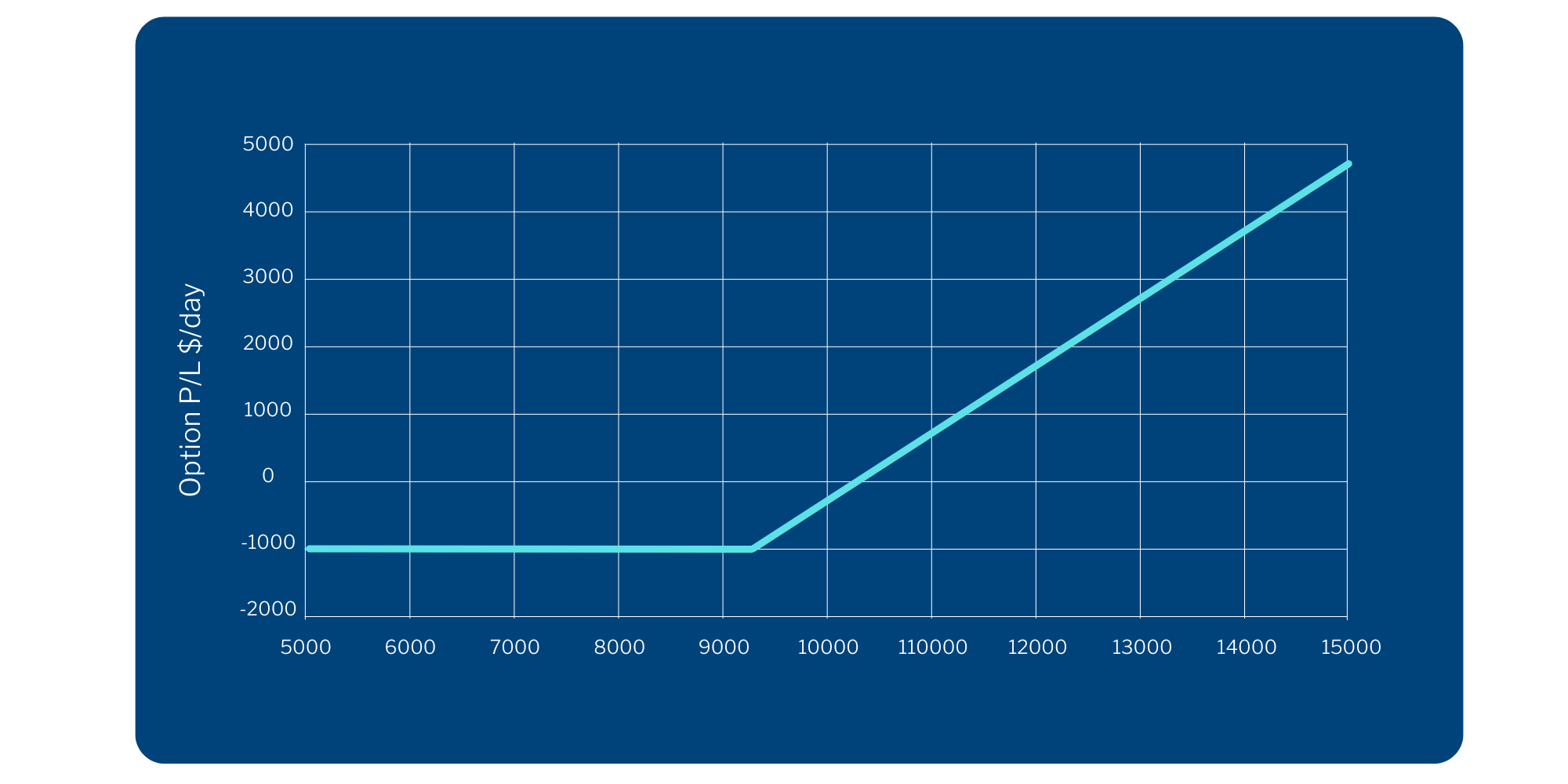
- Gives the holder (buyer) the right, but not the obligation, to BUY an asset at a specified price (the strike price) on a specified maturity date
- The writer (seller) of the option therefore has an obligation to sell the asset, should the holder require
- A call option can provide a guaranteed maximum freight cost for a charterer, for example
Example of a call Option:
Put Option:
- Gives the holder (buyer) the right, but not the obligation, to SELL an asset at a specified price (the strike price) on a specified maturity date
- The writer (seller) of the option therefore has an obligation to buy the asset, should the holder require
- A put option can provide a guaranteed minimum freight income for a shipowner, for example.
Example of a put Option:.png)
How to price Options
The price paid for an option, that is to purchase the option itself, is known as the premium and is paid in full on the day following the option's trade. The premium is also the maximum possible loss to the option holder and the maximum possible gain for the option writer.
A decision as to whether to exercise the option will likely be made based upon its “moneyness”.
- At the money: the underlying asset price equals the strike price
- In the money: for a call option, this will mean the underlying asset price is greater than the strike price, and vice versa for a put option – the option has an exercise value
- Out of the money: for a call option, this will mean the underlying asset price is less than the strike price, and vice versa for a put option – the option has no exercise value.
Options are also traded via a freight options broker (sitting alongside the FFA brokers) and are given up to the Clearing House in the same manner as an FFA trade.
Options trading is more nuanced and technical than trading the underlying FFA market and it is important to thoroughly understand the market and process. The Baltic Academy Advanced Freight Modelling and Trading course provides enhanced education.