During the day, the Freight Assessors will gather market information by speaking with both principals and brokers. The Panellists themselves will have been working within that market developing an idea of what index assessment they will submit at the end of day.
Both Freight Assessors and Panellists work on a central platform known as BDP – Baltic Data Platform.
Before BDP is opened to the Panellists to submit their numbers, and one hour before publication, the Freight Assessors will input a “”ZBEX” number into BDP. This is their own assessment of the route based upon the market information they have gathered. The ZBEX assessment is used for market insights and as a control number for metrics; it is not included in the index calculation.
Principals in the market (ship operator or charterer for the physical routes; FFA trader for the paper) are also able to provide throughout the day, via email to a specific email address, their own assessment of that day’s index. Likewise, one hour before publication, an average of these principal submissions is generated, called the “ZPRIN” number. If a principal has submitted a number that is an outlier from the ZPRIN number, the Freight Assessor will contact them to investigate the reason. Like the ZBEX, the ZPRIN is used for market insights and as a control number for metrics, and is not included in the index calculation.
Principals who are interested in participating in this process, please contact: balticbroker@balticexchange.com
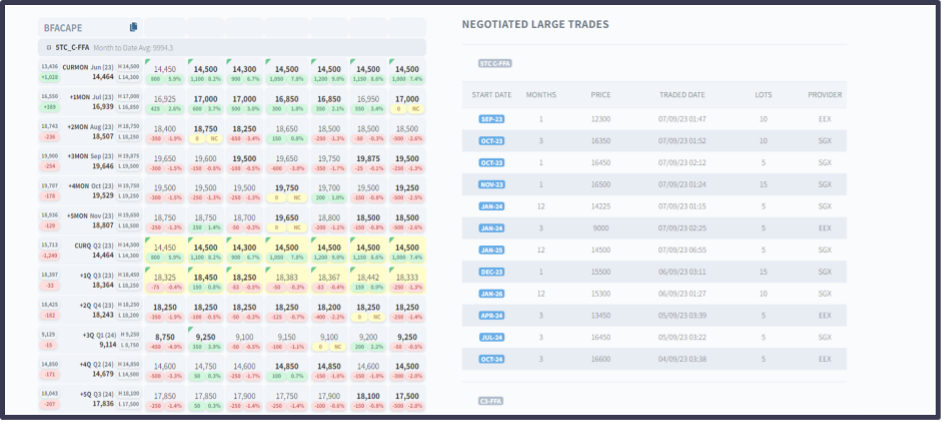
For our Baltic Forward Assessments, price information from the clearing houses on that day’s FFA trades is used as the control numbers for metrics.
The confidential BDP reporting window for Panellists opens 30 minutes before publication, for 15 minutes only. As Panellists they will have a clear idea of the particular index parameters and will submit a relevant number. These parameters can be found in Appendix 2 and 5 of the GMB, and more general guidance to Panellists within Section 7 and also Appendix 4.
Once the Panellists have submitted their numbers, the assessors carry out quality control checks, validating the data received from Panellists using prescribed quality and accuracy standards. This process also ensures that sufficient evidence is provided by Panellists and that no erroneous data is included in the index production.
It is important to note that Freight Assessors will not lead Panellists to submit a particular level, nor will Panellists be told their input is the highest or lowest, or too high or too low. Panellists are asked instead to explain in their own words how they came to their assessment value. This helps the Assessor check the submission is within relevant index parameters and there is sound reasoning behind it, after all, outlier assessments may not be incorrect; they may in fact be the market. Neither the highest nor the lowest submissions are excluded from the final index calculation.
The Panellists themselves can make as many changes to their values as they need within the submission time, until the Assessor locks the BDP grid. Any changes made to the assessment either implemented by the Assessor (fat fingers etc), or requested by the Panellist will be noted in BDP stating the reason for the change and their name or initials. This ensures there is a complete audit trail on production alongside the actual submissions and any Panellist comments.
Snapshot of the Capesize grid during the validation process, pre-publication
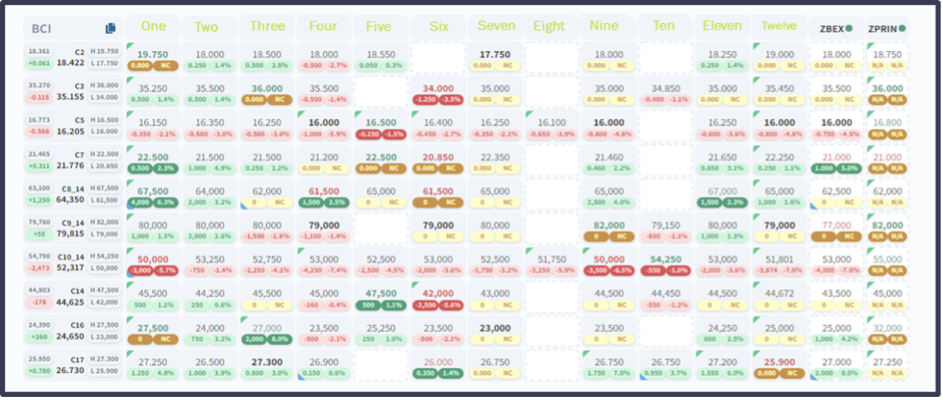
The final 30 minutes before publication is a critical time for the Freight Assessor, particularly for indices with a large number of Panellist assessments to review.
Ingested FFA trades from the Clearing Exchanges are displayed beside the Forward Assessment grid
Please also refer to Appendix 3 of the GMB to review the calculation methodologies for our various oceanbulk TCE (time charter equivalent) and headline indices, and similarly Section 4 of both the FBX Guide and BAI Guide, for the relevant methodologies.
Pre-publication, Senior Assessors within the Baltic freight team will review the Freight Assessors’ work and cross-check that any concerns have been addressed. Senior Assessors are responsible for authorising index publication.
At publication, indices are available via our website, our API feed, our Baltic App and also by email where the data subscriber has set up their account to receive .pdf files. The published data is also accessible via our licenced data partners including Bloomberg and LSEG.
The clearing houses (CME, EEX, ICE and SGX) will receive an end of day report including our relevant physical and forward assessments in order to calculate daily variation margins and final settlements for their Baltic futures products.