Geopolitical fragmentation reshaping shipping
Industry leaders predict trade growth amid rising risk
By Carly Fields
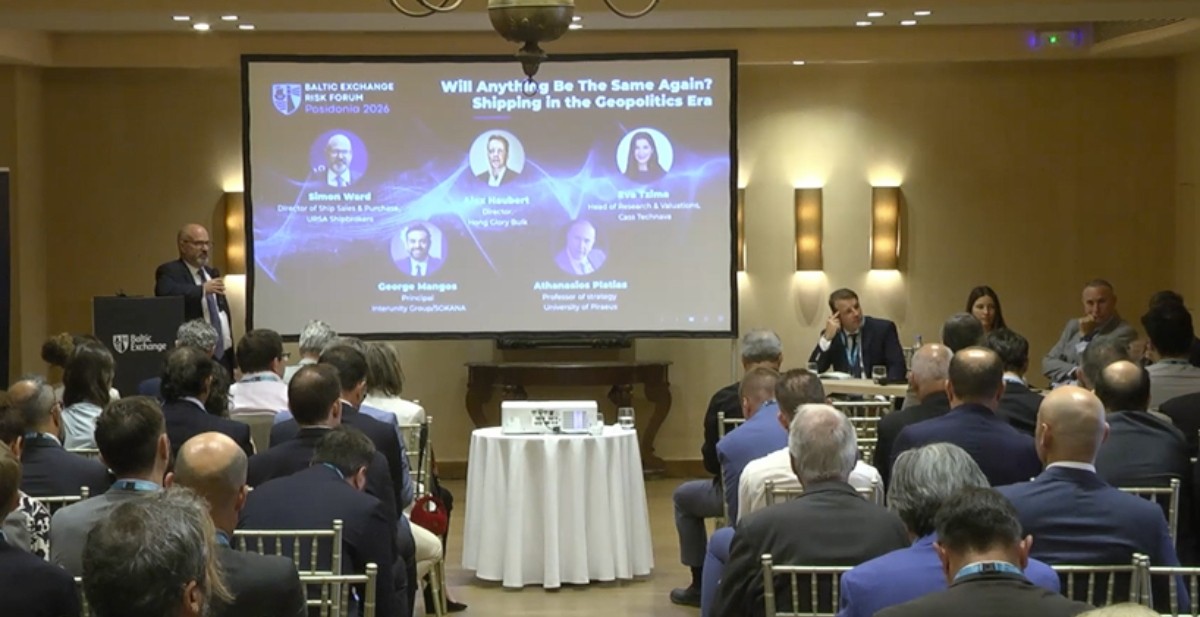
Geopolitical disruption, energy security concerns and the emergence of competing trade blocs are fundamentally altering the way shipping markets operate, according to speakers at a Baltic Exchange panel discussion at Posidonia.
While panellists highlighted growing volatility, regionalisation and strategic rivalry between major powers, they also agreed that global trade volumes and demand for shipping are likely to continue expanding over the coming years.
The discussion brought together shipowners, brokers, analysts and academics to assess how shipping is adapting to a world increasingly defined by geopolitical tensions, supply-chain resilience and shifting trade patterns.
For Alex Haubert, director at Hong Glory Bulk, the transformation has been unfolding over the past five to six years, marking a clear departure from an era characterised by cheap capital and highly optimised global supply chains.
“We moved from a world where the risk rate was zero, money was worth nothing, and moving commodities was all about efficiency, efficiency and price,” Haubert said. He said that low financing costs encouraged companies to stretch supply chains as far as possible while focusing primarily on cost efficiency. However, the pandemic exposed vulnerabilities that many market participants had previously underestimated.
“Supply chains essentially snapped,” he said, explaining that resilience and security have become as important as efficiency.
At the same time, rising interest rates have transformed the economics of commodity trading. According to Haubert, the cost of financing commodity trades has risen significantly, making inventory management and cargo movement more complex and expensive than during the years of ultra-low interest rates.
Piling on
These challenges have been compounded by geopolitical conflicts and disruptions. “When you add to this geopolitics and wars, then you have a perfect storm again, where it's even more about resilience, security, and getting your cargo on time for your customers,” he said. As commodities become more strategically important, shipping is attracting greater scrutiny because vessels effectively become extensions of those supply chains.
The changing geopolitical environment is also altering attitudes towards risk across commodity and freight markets. Haubert noted that traders and market participants are finding it more difficult to price future exposure.
“If you're selling a business forward… you're not only exposed to the freight market itself,” he said. Participants must now consider geopolitical events that may emerge between the time a trade is agreed and executed.
“Not everyone is willing to sell risk at the moment,” he added. As a result, trading houses are increasingly retaining risk internally until conditions become clearer and it can be transferred further along the chain.
From the tanker sector, George Mangos, co-founder and director of SOKANA, argued that the industry is witnessing changes that go beyond immediate market fundamentals. “Shipping has been at the cusp of the fracturing of the global world order for quite some time now, for 15 years,” Mangos said.
He pointed to the emergence of “two entirely separated fuel distribution systems” associated with an increasingly divided world economy. Rather than focusing solely on trade statistics or freight rates, Mangos emphasised the importance of mindset. He said industry participants need to adapt their thinking as established assumptions about globalisation and international trade are challenged.
Mangos also highlighted the potential influence of artificial intelligence and broader technological changes on geopolitical competition. “We are on again on the cusp of something unprecedented in the way in which countries are going to be interacting with one another,” he said. Major powers are seeking to maximise their positions under current rules while they still can, he argued, because future competitive dynamics may look very different. “It'll all change, so this is what we're living now.”
Finance still available
Offering a research and finance perspective, Eva Tzima, head of research and valuations at Cass Technava, noted that although lenders have experienced periods of heightened uncertainty, banks remain active and competitive participants in shipping finance.
“There is appetite, of course,” she said, adding that competition among financial institutions has also intensified pressure on Chinese leasing houses.
Tzima also noted that China has emerged as a significant beneficiary of recent global developments. While acknowledging the strength of the US energy sector, she suggested that recent disruptions and concerns over energy security may accelerate efforts by many countries to diversify away from Western-dominated supply chains.
“I personally believe that China is a big winner out of everything that has happened in the past year,” she said. Tzima argued that the world is unlikely to return to a system dominated by the US in the same way as before and suggested that trade relationships are evolving towards a more multipolar structure.
The prospect of a more fragmented global trading system was also addressed by Athanasios Platias, professor of strategy at the University of Piraeus.
He predicted increasing regionalisation, with stronger trade flows developing within geopolitical blocs and relatively less interaction between competing spheres.
“We will move into different orders, and it's going to be regionalisation,” Platias said. “A lot of trade within all these orders, but not so much between, let's say, East and West.”
Platias also examined the implications for shipbuilding, arguing that Western economies are unlikely to recreate major shipbuilding industries capable of competing with established Asian yards. In his view, larger shipping companies will be better positioned to navigate geopolitical divides by maintaining access to multiple shipbuilding centres and trading jurisdictions, while smaller owners may struggle.
“The smaller ship owners will suffer,” he warned, suggesting that flexibility alone may not offset the challenges posed by a more fragmented commercial environment.
Despite concerns about protectionism and geopolitical rivalry, Platias rejected the notion that globalisation is reversing. “Trade is increasing, and it will increase also in energy,” he said, noting that rising energy demand linked to artificial intelligence and growing middle-class consumption in developing economies should continue to support trade growth.