Geopolitics vs fundamentals: The great tanker disconnect
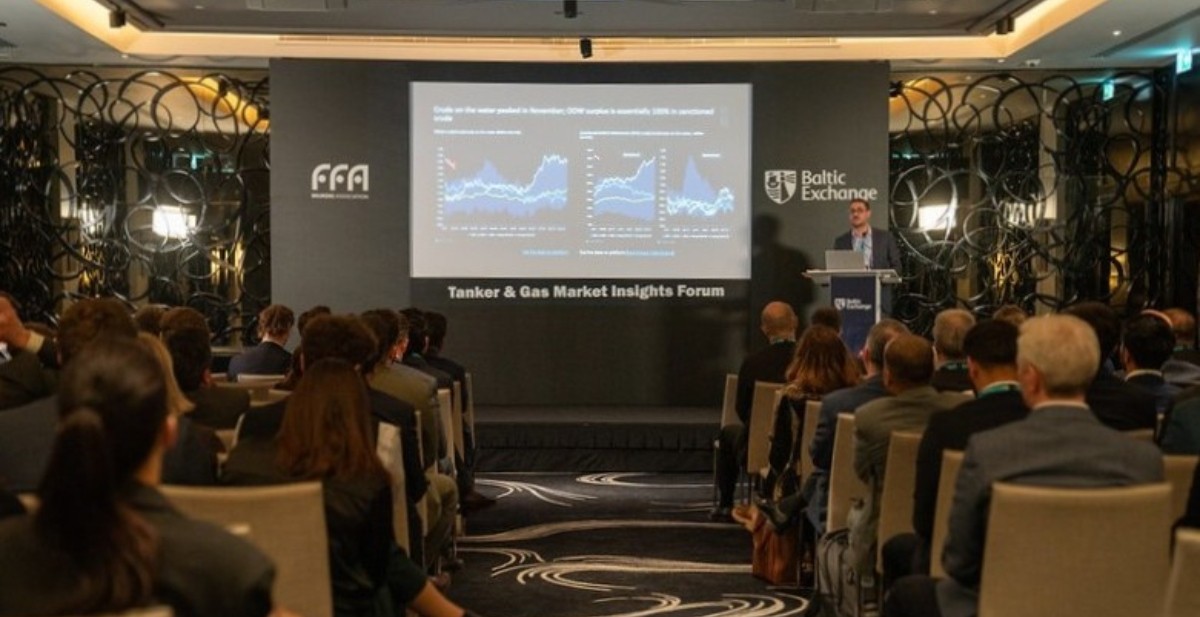
The dirty tanker market is being characterised by imbalances
By Carly Fields
The energy markets of 2025 and 2026 to-date have proven that volatility is the only true constant in the shipping world.
Speaking at the Baltic Exchange Tanker & Gas Market Insights Forum during IE Week 2026, Ioannis Papadimitriou, lead freight analyst at Vortexa, spoke of a market currently caught between the gravity of weakening fundamentals and the buoyancy of geopolitical friction. His assessment was of a sector where traditional supply-and-demand metrics are increasingly at odds with the "eventful" reality of global trade.
The story of the dirty tanker market over the past year has been one of imbalances. Papadimitriou noted that the robust freight rates witnessed through the latter half of 2025 were underpinned by record crude exports and liftings, particularly in the third quarter. However, these liftings were not met by a corresponding rise in arrivals due to a bottleneck of regulatory and sanction-related challenges. This mismatch triggered extraordinary levels of oil on water, surpassing even the peaks seen during the COVID19 pandemic. As Papadimitriou explained, this backlog "turbocharged rates" by severely reducing the available vessel supply.
By the start of 2026, the tide had begun to turn. Data from January showed a drastic drop in exports and liftings, leading to a rebalancing where arrivals finally surpassed new shipments. While oil on water remains at seasonal records, it has receded by approximately 70 to 80 million barrels from the November peaks. The driver of this lingering high volume is no longer mainstream inefficiency but the friction of the dark or shadow fleet.
Papadimitriou highlighted that sanctioned barrels are finding it "incredibly difficult to discharge at their end destination”, a situation that has tightened logistics for the dark fleet while leaving the mainstream fleet to track closer to multi-year seasonal averages.
The Vortexa analysis also revealed the declining efficiency of this shadow fleet. Despite the cumulative growth in the number of vessels operating outside mainstream oversight, their utilisation is actually dropping. Papadimitriou suggested this "highlights the efficiency of sanctions”, as an increasing number of vessels find themselves unable to secure active employment in either the dark trade or the mainstream market. Furthermore, high mainstream freight rates have served as a "disincentive" for owners to transition their vessels into the dark fleet, slowing its growth rate for the first time in several quarters.
The demand side for mainstream tankers—specifically VLCCs and suezmaxes—showed initial strength at the end of 2025, supported by long-haul voyages from the Atlantic to the Pacific and Indian buyers shying away from Russian crude in favour of mainstream grades.
Yet, this momentum is waning. Papadimitriou warned of a "decline in tonne miles" for the largest vessel classes, driven by shorter distances and a concentration of VLCC demand in the Middle East Gulf rather than the Atlantic Basin.
This creates what the analyst described as a significant "disconnect" between fundamentals and current freight rates.
While the maths of tonne-miles suggests rates should be softening, geopolitical tensions—ranging from Venezuela to US-Iran friction—kept prices at the elevated levels seen in late 2025.
However, Papadimitriou cautioned the forum that this is fragile. "If we expect to see the escalation, especially in the Middle East, then we could see a downward correction in freight rates alongside fundamentals," he said, suggesting that the current market strength is largely a "geopolitical premium".
In the mid-sized segment, aframaxes have bucked the trend of their larger cousins. Their recent success has been fuelled by strong US Gulf exports and the transition of Venezuelan oil into the mainstream market. As suezmaxes and VLCCs found employment elsewhere, aframaxes swooped in to take a larger percentage share of voyages out of the Gulf of Mexico and the Caribbean. However, Papadimitriou questioned the longevity of this dominance. With the resolution of pipeline disruptions in the Black Sea and the potential for a US-India trade agreement to bring larger vessels back to the US Gulf, the aframax "exposure" on these trades may soon be limited.
Looking toward the second half of 2026, the "big picture" for dirty tankers rests heavily on China. While Chinese imports were recently constrained by inventory capacity, the expected completion of new storage builds—totalling some 80 million barrels—could generate an additional 200,000 barrels per day of imports.
Papadimitriou estimated this could translate into a demand for at least 12 additional VLCCs per month, providing a much-needed fundamental if geopolitical tensions subside.
The clean tanker market presents a different set of challenges. While rates have remained resilient, Papadimitriou pointed out that tonne-miles are actually lower than 2024 or 2025 levels. The current strength is "driven mainly by the number of voyages, rather than distances”, particularly within the Atlantic Basin. For larger Long Range (LR) vessels, the story is one of supply-side restriction rather than a demand surge.
A critical factor for the clean sector is the continued avoidance of the Bab el-Mandeb strait. Despite peace discussions, Western operators remain in a "wait and see mode”, with only more risk-tolerant, non-Western operators currently transiting the region. Papadimitriou noted that while a gradual return to normality is expected in the second half of the year, this would put "downward pressure on tonne miles" as routes shorten.
Adding to the clean sector's headwinds is a massive wave of new vessel deliveries. In 2026, approximately 63 LR2 deliveries are expected to hit the water, representing a staggering 25% of the current fleet. Without a significant increase in tonne-mile demand—which currently seems unlikely given suppressed diesel demand in Europe—this influx of supply is expected to exert "downward pressure into clean freight rates going forward".
Papadimitriou concluded with a "wild card" scenario: a potential peace deal between Russia and the West. In such an event, the 180 or so poorly maintained and uninsured aframaxes currently trapped in the Dark Fleet would likely head to the scrapyard, potentially allowing modern LR2s to step in and reclaim those trades.