New year, same old uncertainty for chemical tankers
Chemical tanker markets face a convergence of geopolitics and aging fleets in 2026
By Carly Fields
The chemical tanker sector is currently experiencing a period of acute transformation and persistent volatility with a new year that brought the same uncertainty as 2025: shifting trade flows, a looming oversupply of aging vessels, and a fragmented regulatory landscape.
Combined, these are redefining the chemical tanker sector’s rules of engagement for owners and charterers, according to Francesco Tassello, senior analyst at Harbour Marine.
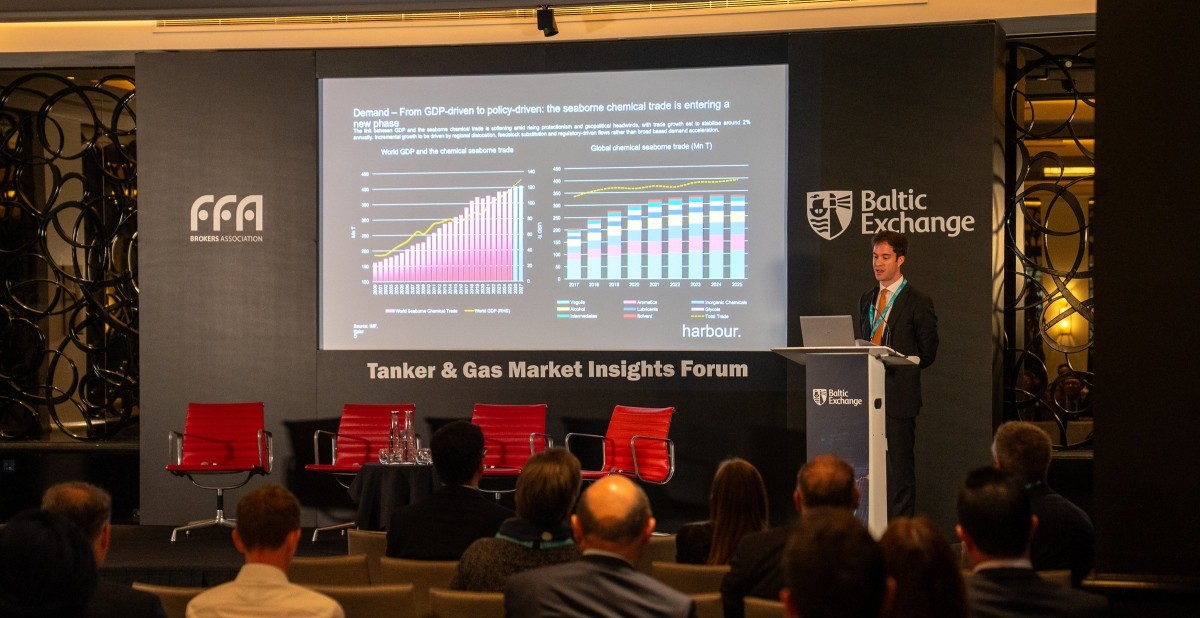
Speaking at the Baltic Exchange Tanker & Gas Market Insights Forum during IE Week 2026, Tassello acknowledged that the optimistic projections many analysts held at the close of 2025 have already been tested by the realities of early 2026. He noted that while the global chemical trade remains in a state of expansion, the drivers behind that demand are becoming increasingly diverse and localised. The historical tether between chemical seaborne trade and global GDP has been strained by a rising tide of protectionism and geopolitical headwinds.
Despite these pressures, Tassello expects actual trade volumes to grow by approximately 2% annually this year.
However, he warned that "scratching below the surface, incremental growth will be cargo specific, and will be increasingly driven by regional dislocation, feedstock substitution and regulation”.
Tassello was speaking before the escalation of conflicts in the Middle East, which present a renewed threat to an industry that is already wrestling with its worst-ever downturn.
Demand picture
One of the shifts in the industry concern the geographical divergence between where chemicals are produced and where they are consumed. This "East versus West" divide is creating a permanent structural support for tonne-mile demand. Tassello pointed out that demand and production growth remain heavily concentrated in the East of Suez, with the Middle East leading supply growth and Far East Asia dominating demand.
While this imbalance is generally "good news for shipping" because it necessitates long-haul imports to offset regional deficits, the reality on the water is more nuanced, he said. In Southeast Asia, for instance, a net long position in products has not automatically translated into increased intra-Asian flows. Instead, due to protectionist measures in China and increased domestic capacity, these products are increasingly finding their way across the Pacific to the US, further stretching global trade routes.
The supply side of the equation presents its own set of contradictions. Tassello observed that the current order cycle for stainless steel coated ships is skewed toward 25,000 dwt ships, as shipyards show a marked preference for more lucrative, larger vessels. He noted that the 25,000 dwt order book has been booming and now represents 57% of the trading fleet, albeit that this figure is driven largely by a low existing fleet profile. This raises a critical question for the industry regarding the "workhorse" of the trade—the 19,000 dwt stainless steel ship.
With an order book of only 5%, the industry is watching closely to see if the larger 25,000-ton units will eventually displace their smaller counterparts on core routes.
However, the primary concern regarding supply is not just what is being built, but what is refusing to leave the market. Above-average earnings over the past several years have acted as a powerful deterrent to scrapping, leading to a significant aging of the global fleet. Tassello recalled a time not long ago when any ship beyond 15 years old was "as good as dead”, but requirements have since shifted to 20 years and now appear to be moving toward the 25-year mark.
This lack of demolition is creating a demographic time bomb; by the end of the decade, Tassello expects about 30% of the fleet to be 20 years old or over. He noted that "with only the oldest ships getting scrapped, the overall age of the fleet is ageing”, a trend that increases oversupply risks for 2026 and 2027.
Geopolitics challenges
There are other challenges to contend with. Tassello referenced a "blip" last year caused by trade tensions that momentarily ground procurement to a halt. While ships began moving again following trade agreements in mid-2025, the shadow of geopolitics remains long.
The industry is also grappling with what Tassello described as an "alphabet soup of acronyms" representing the path toward decarbonisation.
The regulatory landscape, featuring the IMO, EU ETS, and FuelEU Maritime, has created a "mess" that makes compliance both difficult and expensive. This regulatory friction is creating a two-tier market.
The transition to alternative fuels remains in a state of "preliminary adoption”. While LNG and methanol are gaining ground—the latter being particularly popular with producer-owned fleets—most dual-fuel capable ships are still running on traditional fuel oil. Tassello noted that "they will put their capability into practice only when the rules are more clear”. One bright spot for chemical tankers is the rise of biofuels; as "drop-in" fuel mandates take hold, the need to source and transport these products over long distances will create new opportunities for specialised carriers, even as it increases competition for fuel feedstock with the aviation and land-based transport sectors.
In his concluding remarks, Tassello emphasised that while traditional fundamentals like fleet expansion and scrapping are returning to the fore, geopolitics still dominates the horizon. The "Trump card" of policy volatility, China's economic trajectory, and the ongoing stagnation of peace efforts in Ukraine all continue to contribute to a fragmented trade environment.