BAI Index October 2026: Air freight rates remain firm in September with renewed surge in jet fuel yet to feed through

Global air freight rates maintained a firm tone through September, with continuing concerns over conflicts in the Middle East and Ukraine, higher oil prices and rising interest rates continuing to weigh on markets.
After a flattish month in August, the global Baltic Air Freight Index (BAI00), calculated by TAC Data, edged up again by a further +2.4% over four weeks to 28 September, leaving it ahead by +21.7% year-on-year (YoY).
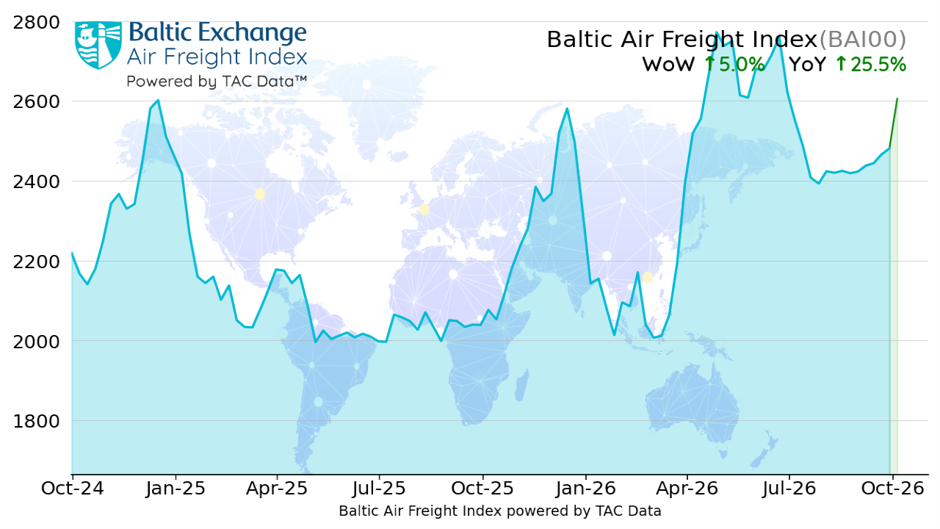
However, pressures on rates were clearly rising, with a further +5.0% surge in the week to 5 October as the market entered the Golden Week holiday period in China, pushing the YoY gain up to +25.5%.
Meanwhile, there were some ongoing shifts in volumes and rates between different lanes following a significant drop in e-commerce into Europe since the end of the de minimis exemption for small parcels entering the European Union and introduction of a new interim flat-rate customs duty.
Meanwhile, there were some ongoing shifts in volumes and rates between different lanes following a significant drop in e-commerce into Europe since the end of the de minimis exemption for small parcels entering the European Union and introduction of a new interim flat-rate customs duty.
Overall rates remained strong, but had not yet risen anything like jet fuel prices, which surged again following further disruption to oil markets due to events in both the Middle East and Russia/Ukraine.
According to the IATA Jet Fuel Price Monitor, based on Platts data, by 2 October, average jet fuel prices were up by more than double the level of 12 months earlier at +108% YoY.
While jet fuel is far from the only input into air cargo costs, it is usually the biggest single input, contributing up to one-third of the total costs depending on other factors like the fuel-efficiency of planes deployed.
After being caught by surprise at the onset of the Iran conflict at the end of February, many carriers had since taken whatever steps they could to prepare for further shocks by securing supplies further forward. However, there is a limit to how far forward this is possible. By late September, sources suggested it could only be another week or so before there might be a bigger impact on rates, as well as types of aircraft used, with more fuel-efficient, two-engine planes preferred over less-efficient, four-engine planes.
After being caught by surprise at the onset of the Iran conflict at the end of February, many carriers had since taken whatever steps they could to prepare for further shocks by securing supplies further forward. However, there is a limit to how far forward this is possible. By late September, sources suggested it could only be another week or so before there might be a bigger impact on rates, as well as types of aircraft used, with more fuel-efficient, two-engine planes preferred over less-efficient, four-engine planes.
BAI Spot rates also remained firm through September, although they did not move up a great deal over the month out of Hong Kong, Shanghai or Korea.
However, BAI Spot rates were significantly up out of India, which was also impacted more rapidly earlier in the year by disruption in the Middle East. By early October, BAI Spot rates out of India were up +70% YoY to the United States and well over +80% YoY to Europe.
The full index of outbound routes from Hong Kong (BAI30) – reflecting the whole spectrum of spot and forward contract business through the world’s biggest airport by cargo volume – gained +6.6% over the four weeks to 5 October, leaving it at +22.3% YoY.
Outbound Shanghai (BAI80) – second only to Hong Kong by volume – edged up +1.0% month-on-month (MoM) to the same date, leaving it at +18.3% YoY.
Out of Europe, rates were generally firmer, with the index of outbound routes from Frankfurt (BAI20) gaining +8.7% MoM to leave it up some +46.0% YoY. Just as it was seen on Transatlantic routes, rates from Europe to China continue to rise, reflecting perhaps the cuts in capacity driven from the opposite direction by the end of de minimis.
Outbound London Heathrow (BAI40) maintained its recent volatile pattern, gaining +15.0% MoM to leave it more narrowly ahead at +13.8% YoY.
Out of the Americas, rate patterns were also pretty firm, with the index of outbound routes from Chicago (BAI50) gaining +28.2% MoM. That left it up by a whopping +77.2% YoY, although compared with levels that were pretty depressed a year ago when standoffs over tariffs and trade terms were hitting volumes.
Meanwhile, underlying the numbers were some significant shifts in activity between different lanes.
This came out pretty clearly at the annual EU Cross-Border E-Commerce Forum held in September in Liege, which has become a highly significant European airport by focusing primarily on cargo, with volumes only exceeded narrowly by Frankfurt, London, Paris and Amsterdam.
Speakers highlighted the significant drop in e-commerce volumes into the EU since the end to the old de minimis regime. Following the introduction of a new interim flat-rate duty of €3 per item at the start of July, demand had certainly been hit, various speakers said.
Ryan Keyrouse, Co-founder and CEO of Rotate, estimated that e-commerce volumes into the EU had plummeted by about -24%, with the market responding by dropping something like 5,000 dedicated freighter flights from Asia-Europe lanes. This had not impacted all airports evenly, he added, with overall volumes into Liege holding up better than most other airports in Europe.
Other speakers put the drop in e-commerce volumes higher, with Maarten Wormer, Head of Consulting at Aevean B.V., putting the fall on China-Europe lanes at more like -29%, but also highlighted some important nuances in the figures.
Kristian Vanderwaeren, General Administrator of Customs and Excise, Federal Public Service Finance (Belgium), said that so-called H7 declarations for low-value items – previously covered by the de minimis exemption – fell some -53% between July 2025 and July 2026. On the other hand, he said declarations (for goods declared) in the first half of 2026 had more than doubled over the same period, up +102%.
As other speakers pointed out, this suggests that although trade in cheap items may have become uneconomic under the new flat-rate fee, the market had already responded rapidly with a considerable amount of bundling or aggregating of smaller items into bigger packages. As Vanderwaeren pointed out, this had also significantly boosted revenues from customs duties into the EU.
In a wide-ranging set of panel discussions, a group of leading freight forwarders also cited other current issues for airports around the world.
For instance, Asok Kumar, CEO of Morrison Express, highlighted the issue of security, noting that some semiconductor chips had now become more valuable than gold, and that airports, such as Taipei, handling large volumes were not really set up yet for the escalating scale of trade in them.
Henk Venema, EVP of Global Air Freight at DHL, also highlighted the need for airports to invest more in ground handling capabilities, such as Bangkok, which he said needed to develop much more to accommodate rapid growth.
Given the backdrop of macroeconomic issues – from oil and other commodities to levels of government debt and rising interest rates in the developed world – speakers in Liege were generally cautious about the outlook for rates into the coming peak season.
Nevertheless, with jet fuel prices higher again, it seemed more likely than not that this would put a hard floor under air freight rates, and that rates would indeed continue to push higher as peak season approaches.
Going forward TAC is also in the process of adding various new dimensions to the service – including TAC Explorer, providing guidance on rates for hundreds of additional lanes, as well as AI-driven reports to help explore the characteristics of each individual lane tracked. Stay tuned for more details.
Neil Wilson, TAC Editor
Neil Wilson is Editor of TAC Index, which provides independent, accurate and actionable global air freight data, allowing our customers to make comparative, cost-effective and intelligent air freight decisions.
Neil has more than 30 years’ experience in financial journalism and publishing, specialising mainly in derivatives and alternative investments. He has contributed to various publications including The Financial Times, The Economist and Risk magazine. He has also been a guest speaker at many industry events.
Neil has a B.A. with Honours in Philosophy, Politics and Economics from the University of Oxford.
Receive monthly air freight market reports direct to your inbox.