BAI Index August 2026: Renewed strikes in the Gulf and surging jet fuel – yet air freight rates continue trending lower in July

July was a strange month in air cargo markets. After the ceasefire in June, there were renewed hostilities in the Middle East between the United States and Iran, leading to a renewed surge in jet fuel prices. However, overall air freight rates, as tracked by TAC Index, mostly continued to fall.
With the fragile ceasefire between the US and Iran starting to unravel, and the two sides trading strikes across the Gulf, jet fuel prices started to rise again and continued for most of July.
According to IATA’s Jet Fuel Price Monitor, based on Platts data, jet fuel prices increased for four successive weeks through 24 July. Even after a slight fall over the week to 31 July fuel prices were still up some +76.4% versus the previous year.
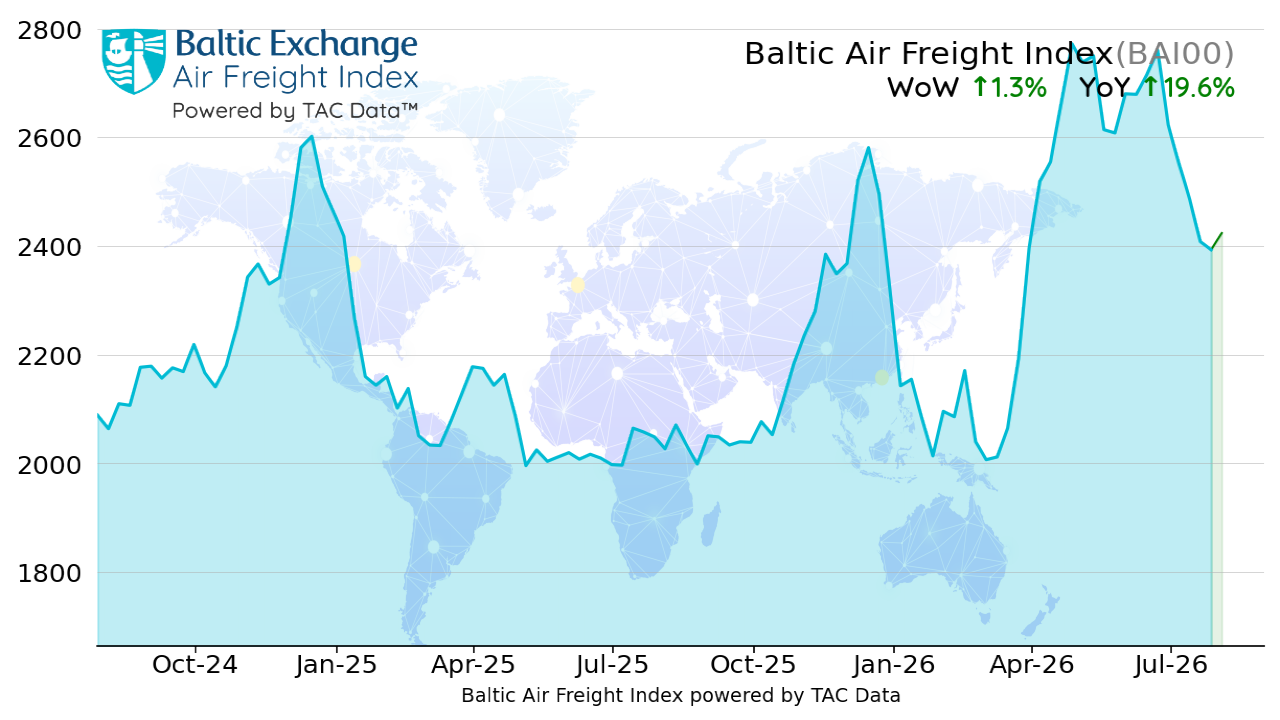
Yet the global Baltic Air Freight Index (BAI00) calculated by TAC did virtually the opposite, falling for five successive weeks through 27 July, losing -8.8% month-on-month (MoM), leaving it at only +16.8% year-on-year (YoY).
There was then a small rise over the week to 3 August, leaving the BAI00 index down -5.0% MoM and at +19.6% YoY. That was still well ahead of where it was in 2025 but nothing like the highs seen in March and April.
Of course, jet fuel is not the only input into the running costs of an airline. There is also the very significant cost of acquiring or leasing the aircraft, as well as hiring the skilled personnel to run it, plus various other fixed costs. But jet fuel is certainly a key input, typically accounting for one-third or more of a carrier’s total expenses.
So why did air freight rates not rise in July as they had done so spectacularly in March after the US and Israel first launched air strikes against Iran?
Sources pointed to a number of factors, including the fact that we were now entering the summer or ‘low season’ when there is usually a lull in air cargo rates. That often occurs when the summer holidays start, with more passenger traffic, which may increase demand for jet fuel.
So why did air freight rates not rise in July as they had done so spectacularly in March after the US and Israel first launched air strikes against Iran?
Sources pointed to a number of factors, including the fact that we were now entering the summer or ‘low season’ when there is usually a lull in air cargo rates. That often occurs when the summer holidays start, with more passenger traffic, which may increase demand for jet fuel.
But it also adds extra bellyhold capacity, particularly on certain lanes, such as Transatlantic routes.
There were also specific one-off factors, such as the end of the de minimis regime for small parcels entering the EU – taking effect from the start from July – leading to a sudden drop in volumes from Asia to Europe.
The latter effect seemed to be reflected in BAI Spot rates out of Hong Kong to Europe, which fell pretty steeply from HK$42.53 per kilo on 30 June to HK$35.08 by 31 July. That was despite reductions in capacity on Asia-Europe lanes, sources suggested, with some freighters withdrawn for maintenance and others redeployed to other lanes.
By contrast, BAI Spot rates from Hong Kong to the US remained much firmer. HK to the US East Coast dropped only a little from HK$53.49 per kilo on 30 June to HK$50.78 by 31 July. HK to the West Coast also dropped only marginally from HK$49.43 to HK$46.34 between the same dates, with volumes continuing to be strong.
By contrast, BAI Spot rates from Hong Kong to the US remained much firmer. HK to the US East Coast dropped only a little from HK$53.49 per kilo on 30 June to HK$50.78 by 31 July. HK to the West Coast also dropped only marginally from HK$49.43 to HK$46.34 between the same dates, with volumes continuing to be strong.
But the biggest factor, sources suggested, is that this time carriers were simply better prepared for further market shocks, through various hedging strategies and methods to secure jet fuel supplies further forward.
Back at the end of February when the US and Israel attacked Iran – and Iran responded by hitting oil and gas infrastructure across the Gulf– many carriers were taken by surprise. This time, according to one source, they may have had to pay more for jet fuel but were not so worried about finding supplies.
The index of outbound routes from Hong Kong (BAI30) – reflecting the full spectrum of spot and forward contract rates to multiple destinations from the world’s busiest cargo airport – fell in line with the global index over the month, losing -9.6% over four weeks to 27 July to leave it at +16.5% YoY. After a small rise in the week to 3 August, it was at +22.0% YoY.
Outbound Shanghai (BAI80) – second only to Hong Kong by volume globally – fell a similar -8.8% MoM to 27 July to leave it at +23.3% YoY. After a modest fall over the week to 3 August, it was at +20.5% YoY.
From Shanghai and other major cargo centres in South East Asia, rates were generally softer to Europe while remaining a little firmer on Transpacific lanes.
However, from some locations in North Asia, such as Taiwan and Seoul – both big exporters of semiconductors, rates were on the rise again through month end, especially to the US.
From Europe, the index of outbound routes from Frankfurt (BAI20) was falling steadily for most of the month – but then rebounded strongly over month-end, taking it to a gain of +4.4% over four weeks to 3 August and back into positive territory YoY at +32.1%. Outbound London Heathrow (BAI40) by contrast went the other way, being boosted for much of July by firmer rates on disrupted lanes to the Middle East, but then dropping sharply over month-end to leave it at -11.6% YoY.
From Europe, the index of outbound routes from Frankfurt (BAI20) was falling steadily for most of the month – but then rebounded strongly over month-end, taking it to a gain of +4.4% over four weeks to 3 August and back into positive territory YoY at +32.1%. Outbound London Heathrow (BAI40) by contrast went the other way, being boosted for much of July by firmer rates on disrupted lanes to the Middle East, but then dropping sharply over month-end to leave it at -11.6% YoY.
From the US, rates generally remained firm through July, although the index of outbound routes from Chicago (BAI50) dipped -3.9% MoM to 3 August, leaving it at +21.0% YoY.
From a global macro perspective, markets continued to fixate on the AI trade.
There was continued debate not only about who the winners might be between competitors like Anthropic, OpenAI and others including Chinese ‘open source’ competitors. Conversations continue to be about the sheer scale of investment in the sector, with some believing outcomes may yet exceed expectations.
Many investors were fretting about whether such levels of investment can ever be justified by returns, given the heroic levels of growth in revenues and profits needed, or even sustainable given the scale of growth implied for data centres, power generation and network capacity.
All of this led to further wobbles in equity markets in July, with sharp falls during the month for some big tech players including semiconductor producers like Samsung and SK Hynix in Korea, which had only recently reached giddy new highs.
It was too early to tell whether such short-term volatility might translate into a more general sell-off and the bursting of the ‘AI bubble’ as some have been predicting.
According to TAC Freight data, air freight rates out of Korea and Taiwan – both big exporters of semiconductors and related kit – were rebounding again at month-end, especially to the US. For now at least, they remain a long way up YoY and comfortably above the global averages.
Going forward TAC is also in the process of adding various new dimensions to the service – including TAC Explorer, providing guidance on rates for hundreds of additional lanes, as well as AI-driven reports to help explore the characteristics of each individual lane tracked. Stay tuned for more details.
Neil Wilson, TAC Editor
Neil Wilson is Editor of TAC Index, which provides independent, accurate and actionable global air freight data, allowing our customers to make comparative, cost-effective and intelligent air freight decisions.
Neil has more than 30 years’ experience in financial journalism and publishing, specialising mainly in derivatives and alternative investments. He has contributed to various publications including The Financial Times, The Economist and Risk magazine. He has also been a guest speaker at many industry events.
Neil has a B.A. with Honours in Philosophy, Politics and Economics from the University of Oxford.
Receive monthly air freight market reports direct to your inbox.