BAI Index September 2026: Air freight rates remain firm through late summer ‘low season’

August was a tricky month for markets – following a sharp reversal in momentum, with huge US federal deficit and debt levels then coming under scrutiny amid continuing tensions in the Persian Gulf. With ongoing problems for ocean shipping through the Strait of Hormuz, jet fuel prices, which had been easing lower early in the month, also started to rise again.
Yet air freight rates moved relatively little.
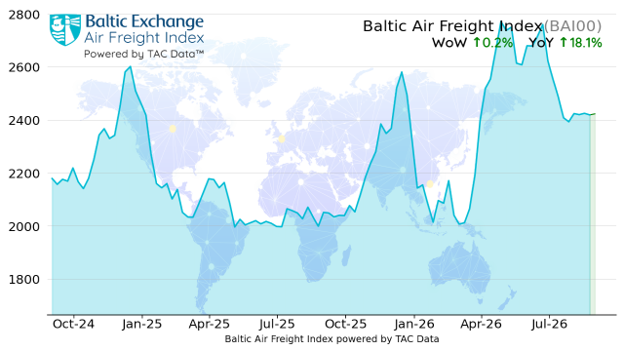
Over the four weeks to 31 August, the global Baltic Air Freight Index (BAI00) was almost exactly unchanged, with little volatility over the month, leaving it still up some +18.1% over 12 months. In contrast to July, when rates fell for five successive weeks despite jet fuel prices going in the opposite direction, August saw rates rising for no less than four successive weeks.
In August, the pressure from jet fuel costs initially eased, with prices falling in the first week of the month, before rising again alongside a resurgence of tensions in the Gulf. According to the IATA Jet Fuel Price Monitor, average jet fuel prices gained an average of +8.2% over the month to 28 August, putting them up some +74.2% year-on-year (YoY).
However, air freight rates barely moved by comparison. Nevertheless, rates remained at relatively elevated levels at a time of year when people take summer holidays and cargo volumes usually ease off. This summer or ‘low season’ period often sees rates falling through a combination of demand easing and passenger traffic increasing, which can add extra bellyhold capacity.
There were also reports that volumes dropped on certain key lanes, most notably Asia-Europe following the end of the de minimis regime in July for small parcels entering the European Union. That was noticeable in the data, with China-Europe rates falling and looking much weaker YoY (at +11.3% to 31 August) despite cuts in capacity than China-US rates (at +28.7% YoY) as transpacific volumes continued to be higher than in 2025.
There were also reports that volumes dropped on certain key lanes, most notably Asia-Europe following the end of the de minimis regime in July for small parcels entering the European Union. That was noticeable in the data, with China-Europe rates falling and looking much weaker YoY (at +11.3% to 31 August) despite cuts in capacity than China-US rates (at +28.7% YoY) as transpacific volumes continued to be higher than in 2025.
Asia-Europe volumes and rates were falling over much of July and into early August, but there were also signs the market was beginning to adjust to the EU’s new interim flat-rate customs duty, with rates starting to stabilise in mid to late August.
BAI Spot rates from Hong Kong did not change much in August.
From HK to Europe, BAI Spot dipped a little from HK$35.27 per kilo at the end of July to HK$33.63 by 31 August. HK to the US East Coast was little changed from HK$50.84 per kilo at end-July to HK$49.93 by 31 August, while HK to the US West Coast fell slightly from HK$46.45 to HK$45.62.
From HK to Europe, BAI Spot dipped a little from HK$35.27 per kilo at the end of July to HK$33.63 by 31 August. HK to the US East Coast was little changed from HK$50.84 per kilo at end-July to HK$49.93 by 31 August, while HK to the US West Coast fell slightly from HK$46.45 to HK$45.62.
But the overall index of outbound routes from Hong Kong (BAI30) – reflecting the full spectrum of spot and contract rates from the world’s biggest airport by cargo volume – remained strong throughout the month, gaining +1.8% over four weeks to 31 August, leaving it still well up at +20.5% YoY.
Outbound Shanghai (BAI80) was similar, edging up +0.4% over those same four weeks, leaving it at +17.5% YoY. Elsewhere out of Asia, rate patterns were varied. From hubs in Southeast Asia, like Hanoi and Bangkok, as well as from India, there was something of that summer lull for much of August, although this firmed up towards month-end and still remained well up YoY.
From hubs in North Asia, such as Seoul and Taiwan, rates continued to be firmer. This was driven by the continuing boom in demand for semiconductors and other AI-related kit, with some carriers viewing that as a potentially key factor for the upcoming peak season.
Out of Europe, the market was generally a little weaker, with rates on transatlantic lanes easing a bit mid-month as they often do during the late summer period, although still well up YoY.
Out of Europe, the market was generally a little weaker, with rates on transatlantic lanes easing a bit mid-month as they often do during the late summer period, although still well up YoY. The index of outbound routes from Frankfurt (BAI20) dipped -17.3% over the four weeks to 31 August, leaving it ahead by +11.7% YoY. By contrast, outbound London Heathrow (BAI40) continued its recent volatile pattern, gaining +24.1% month-on-month (MoM) to leave it ahead though at only +7.8% YoY.
Out of the Americas, rates were generally firmer, although the index of outbound routes from Chicago (BAI50) shed some -4.0% MoM. That left it up +30.9 % YoY, although this is on comparison to weak levels a year earlier when volumes were hit by stand-offs over tariffs and trade terms.
From a global macro perspective, markets continued to be overshadowed by tensions in the Middle East and ever changing expectations about medium or longer term disruptions to the oil market, and related oil products like jet fuel. Market sources suggested that – given a lasting resolution in the Gulf – oil prices could plummet, with big producers like the UAE (after leaving OPEC), Iraq and Iran (if the US blockade were lifted) all set to expand exports dramatically, creating a potential glut. But given the ongoing stand-off in the Strait of Hormuz, crude oil prices spent much of the month not falling but rising and then oscillating around $90 a barrel. Data showed that the ‘crack spread’ between crude and jet prices was also widening again, putting jet fuel up much more than crude.
All of this also raised the spectre of higher inflation – if oil prices do remain elevated – and markets began to fret about gargantuan levels of government debt in the United States and other Western economies. This seemed to raise the likelihood of higher interest rates, which would hit prospects for economic growth and capacity to finance the debt.
AI continued to be a major topic in August. The sudden drop in semiconductor stocks during July led to steep falls in Samsung and SK Hynix, dragging the whole Korean KOSPI index down by more than 20% over that month.
In August, it seems markets were taking a pause to absorb this sudden ‘momentum reversal’, with the US S&P500 index and other leading equity indices, including the Nikkei in Japan and the DAX and FTSE100 in Europe, flattish over the month.
Looking ahead, sources suggest that if e-commerce activity stays on the same high trajectory, the biggest swing factor for the strength of peak season may be how the AI theme continues to play out.
Some suggested that the recent momentum reversal may reflect investors pausing for thought about the sheer scale of investments by so-called ‘hyperscalers’ like Amazon, Microsoft and Google in the race to build and operate huge global data centres.
On the other hand, others suggest that the recent correction was perhaps exaggerated by rapid deleveraging, while the underlying performance of those firms is still strong. If so, that race to build data centres could well escalate demand further in the final quarter through the traditional peak season.
Going forward TAC is also in the process of adding various new dimensions to the service – including TAC Explorer, providing guidance on rates for hundreds of additional lanes, as well as AI-driven reports to help explore the characteristics of each individual lane tracked. Stay tuned for more details.
Neil Wilson, TAC Editor
Neil Wilson is Editor of TAC Index, which provides independent, accurate and actionable global air freight data, allowing our customers to make comparative, cost-effective and intelligent air freight decisions.
Neil has more than 30 years’ experience in financial journalism and publishing, specialising mainly in derivatives and alternative investments. He has contributed to various publications including The Financial Times, The Economist and Risk magazine. He has also been a guest speaker at many industry events.
Neil has a B.A. with Honours in Philosophy, Politics and Economics from the University of Oxford.
Receive monthly air freight market reports direct to your inbox.